Synthesit and chemotherapy for oral cancer: what did one clinical case show?

Case Report

Rusnac Angela1 and Shahbaz Baig2

1. Multidisciplinary Clinic, ALFA Diagnostic Subdivision, Moldova.
2. Independent Medical College, Faisalabad, Punjab, Pakistan.

The scientific article we are reviewing describes a rather rare situation - an attempt to support a patient's blood during severe chemotherapy with iron supplementation Synthesit (a proprietary form of iron in the form of ferricitrate) in a woman with stage III oral cancer.

The authors do not prove that the drug works wonders, but they accurately show that against the background of its administration, it was possible to slightly improve red blood counts and continue treatment. Let's take a step-by-step look at exactly what happened and how to treat it.

Oral cancer and chemotherapy: why blood is "falling"

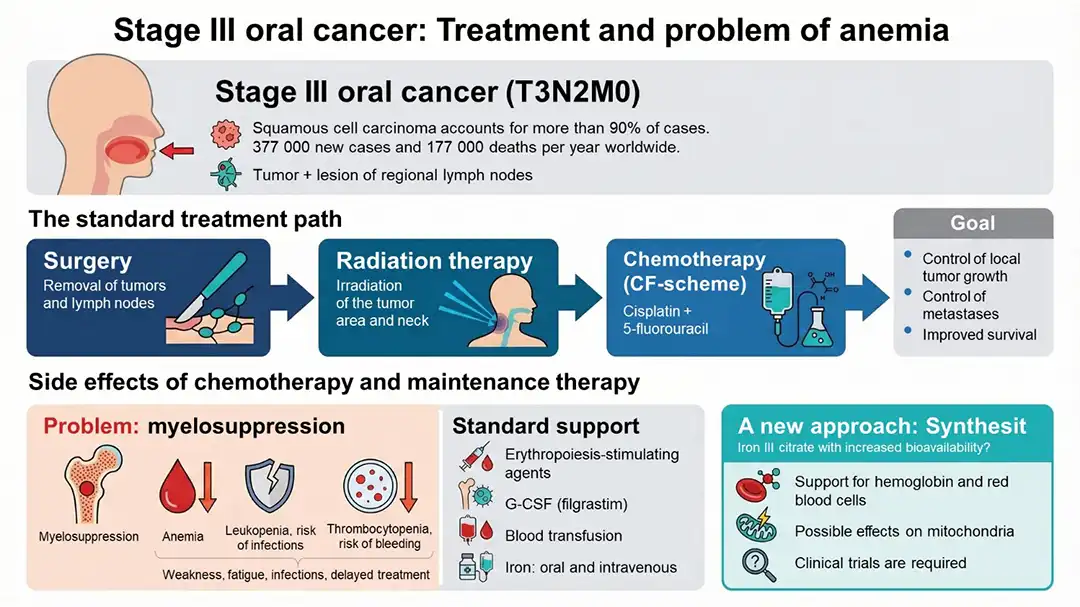
Oral cancer is an aggressive tumor, most often squamous cell carcinoma. More than 90% of the tumors in this area belong to this type, and hundreds of thousands of new cases are diagnosed worldwide every year.

Stage III is characterized by:

  • large tumor
  • lesion of regional lymph nodes

Standard treatment usually includes:

  • surgery to remove part of the tissues and lymph nodes
  • then radiation therapy
  • and/or chemotherapy (often a regimen with cisplatin and 5-fluorouracil)

__wf_reserved_inherit

Chemotherapy affects not only the tumor, but also the bone marrow, the "blood factory." This leads to:

  • anemia – low hemoglobin and red blood cells
  • leukopenia – few white blood cells
  • thrombocytopenia – decreased platelets

Hence, weakness, fatigue, the risk of infections and bleeding, and sometimes the need to postpone or cancel courses of chemotherapy.

To combat this, use:

  • blood-forming stimulants (erythropoietin, G-CSF, etc.)
  • blood transfusion
  • iron preparations (oral or intravenous)

But even with this, many patients have moderate improvements and chemotherapy has to be adjusted.

What is Synthesit and how does it differ from regular iron?

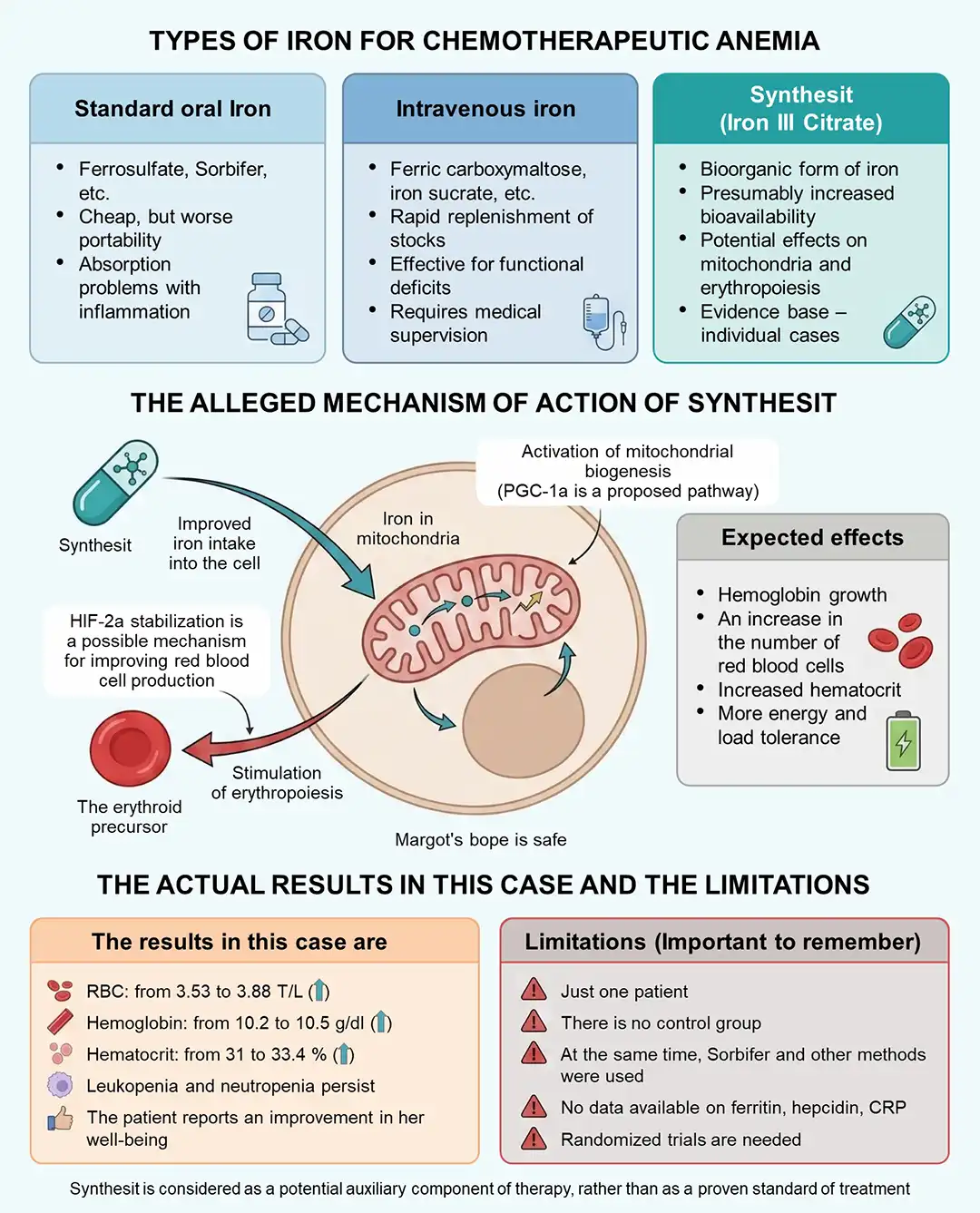
Synthesit is a dietary supplement containing iron in the form of ferric iron (III) citrate (ferric iron III citrate). The authors of the article describe it as:

  • "bioorganic" iron
  • with potentially better digestibility
  • with possible effects on mitochondria and regeneration processes

According to the data they cite:

  • Ferricitrate can activate mitochondrial biogenesis through the PGC-1a pathway
  • It can stabilize the HIF-2a factor associated with the regulation of red blood cell formation
  • Synthesit improved cognitive function and learning in animal experiments
  • There are separate clinical cases where it has been used in patients with cancer and other problems (pancreatic cancer, neuropathy, dyslipidemia)

Important: so far, these are mostly either preclinical data or isolated clinical cases, rather than large randomized trials.

The patient's story: who she is and how she was treated

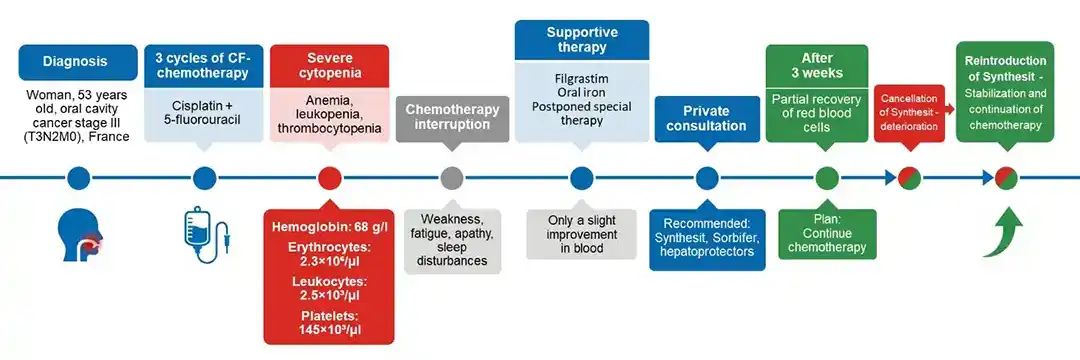
Patient M., 53 years old, stage III oral cancer (T3N2M0), with lymph node involvement. She received CF (cisplatin + 5-fluorouracil) chemotherapy in France.
__wf_reserved_inherit

After three courses, she developed:

  • severe anemia
  • leukopenia
  • thrombocytopenia

Symptoms:

  • severe fatigue
  • weakness
  • apathy
  • sleep disturbance

Blood tests at this point showed severe inhibition of hematopoiesis:

  • hemoglobin 68 g/l
  • red blood cells 2.3×10⁶/ml
  • white blood cells 2.5×10³/ml
  • platelets 145×103/ml

Against this background, the chemotherapy had to be interrupted. The patient was prescribed:

  • filgrastim (white blood stimulation)
  • iron preparations
  • a pause in specialized treatment

However, blood recovery was weak, and his health remained poor.

Later, the patient came to a private consultation, where she was assigned:

  • Synthesit
  • Sorbifer (a common iron preparation)
  • hepatoprotectors

And they recommended retaking the tests in three weeks.

How the doctors' work was organized: design of surveillance

This is not an experiment with a control group, but a description of a single case.

  • Type of study: longitudinal observation of one patient
  • **What was analyzed: **– red blood cells (RBC) – hemoglobin (Hb) – hematocrit (Hct) – white blood cells (WBC) and blood formula – platelets
  • At what points: before and after the appointment of Synthesit and Sorbifer, against the background of ongoing chemotherapy

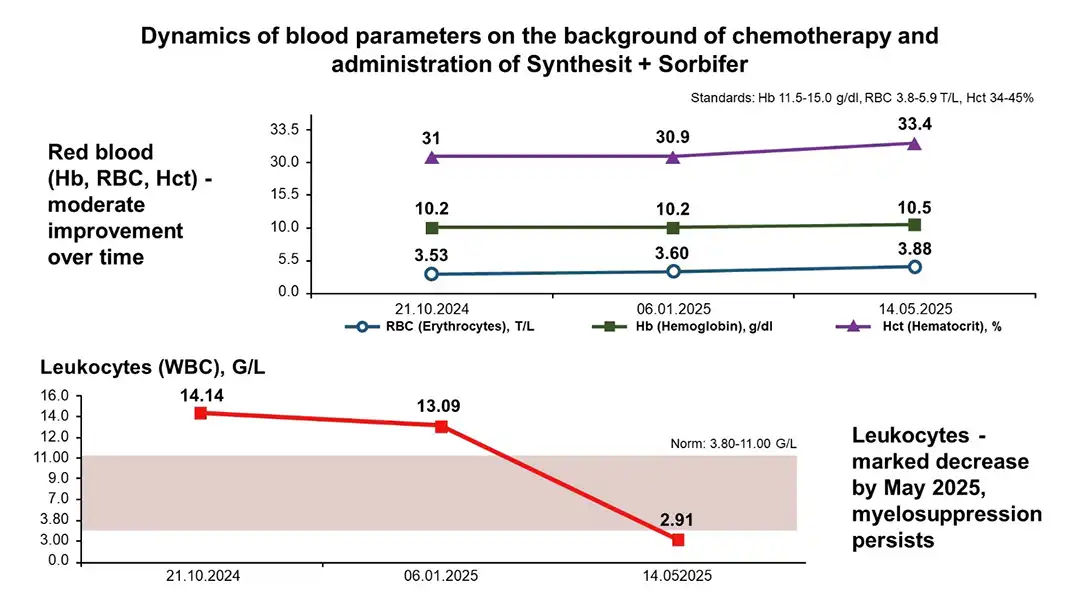
Below is Table 1 with the dynamics of the main blood parameters for the period from October 2024 to May 2025, and below it is a graph (Fig. 1), which shows a gradual change in these parameters over time.

Red Blood test results: a small but important improvement

Threekey points can be traced according to Table 1: On 10/21/2024, 01/06/2025 and05/14/2025.
__wf_reserved_inherit

Red blood cells and hemoglobin

  • RBC: – was 3.53 T/L – became 3.88 T/L (by May 2025)
  • Hemoglobin: – was 10.2 g/dl – became 10.5 g/dl
  • Hematocrit: – increased from 31 % to 33.4 %

The normal values for women according to the table are RBC 3.8-5.9 T/L, Hb 11.5-15 g/dl. That is, the patient remained in the zone of moderate anemia, but the curves crept up, not down, which is not bad for ongoing chemotherapy.

Figure 1 on the same page shows that:

  • RBC, Hb and Hct are growing gradually
  • the average erythrocyte indices (MCV, MCH, MCHC) do not give any special changes - they are relatively stable

This does not indicate a miraculous recovery, but a partial restoration of erythropoiesis (the formation of red cells) after the connection of iron, including Synthesit.

White Blood: it's much worse here

In the same place, in Table 1, it is clearly seen that the situation with white blood is the opposite.

  • WBC (leukocytes): – October 2024 – 14.14 G/L (even higher than normal) – January 2025 – 13.09 G/L – May 2025 – only 2.91 G/L (below the reference range of 3.8-11 G/L)

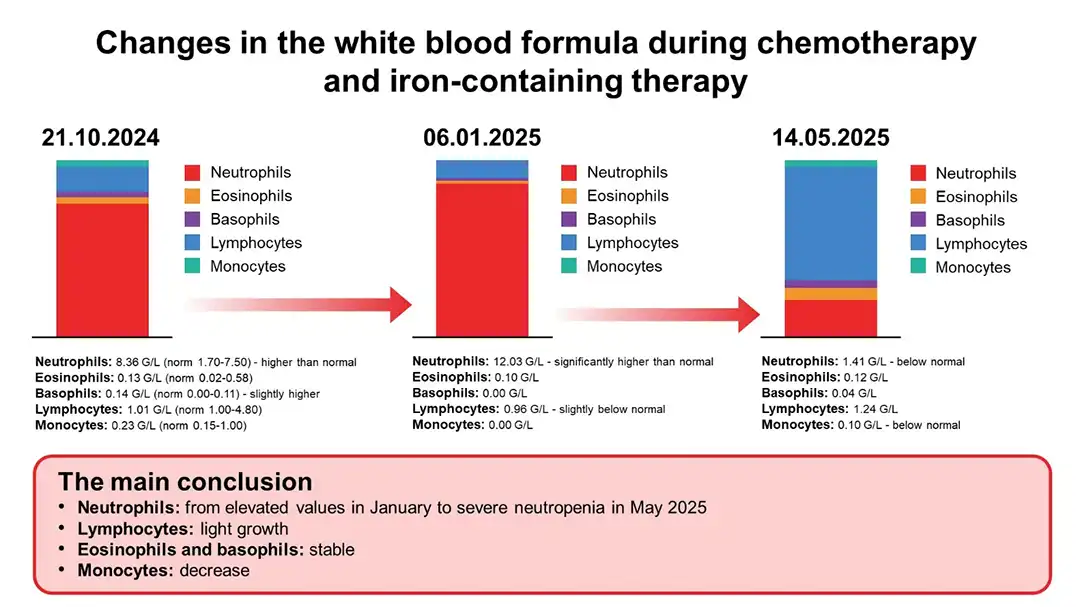
The detailed blood formula is given in Table 2:
__wf_reserved_inherit

  • neutrophils: – January – 12.03 G/l – May – 1.41 G/L (sharp drop)
  • eosinophils and basophils are within the normal range, without noticeable fluctuations
  • lymphocytes – slightly increased (from 0.96 to 1.24 G/L)
  • monocytes decreased (from 0.23 to 0.10 G/L)

In the figure, this can be seen as a sharp "drop" in the neutrophil line by May 2025.

The authors interpret it this way:

  • Synthesit and Sorbifer helped restore red blood
  • but myelosuppression (bone marrow depression) on the part of white blood and immunity, it persisted
  • neutrophils were particularly affected, which is important from the point of view of infectious complications

How did the patient feel

According to the doctors' description:

  • against the background of Synthesit and Sorbifer, the patient improved: – energy level – appetite – tolerability of chemotherapy
  • upon discontinuation of Synthesit, blood counts worsened again, and well-being decreased
  • upon repeated administration, the drug was associated with a new stabilization of parameters and continued treatment

But it is important to remember: these are subjective sensations + one clinical case, without a control group and "blindness".

What do the other works referenced in the article say

The authors provide a short literature review on the topic of iron and Synthesit:

  • there is a case in a patient with pancreatic cancer where Synthesit was associated with improved immune performance and neutrophil levels
  • a case of a decrease in chemotherapeutic neuropathy in a patient with fallopian tube cancer on the background of Synthesit is described
  • in another case, ferricitrate was used for anemia on the background of niraparib therapy (ovarian cancer), which avoided severe toxicity and transfusions

At the same time, the authors recall major work on intravenous iron:

  • Meta-analyses show that intravenous iron effectively raises hemoglobin and reduces the need for transfusions
  • NCCN and American Society of Hematology recommendations give priority to intravenous forms of iron for chemotherapeutic anemia
  • oral iron works less stably, especially against the background of inflammation and impaired absorption

Againstthis background, the authors consider Synthesit as potentially:

  • a more "mild" oral form in terms of tolerability
  • with theoretically better delivery of iron to cells
  • but with a very limited evidence base

Strengths and weaknesses of the work

Positive

  • detailed description of one real clinical case
  • clear dynamics of blood tests (tables, graphs)
  • accurate interpretation: the authors do not claim that Synthesit is a panacea, but rather talk about a "possible supportive role"
  • comparison with existing data on anemia in chemotherapy and iron treatment

Limitations

The authors honestly list what is missing from this study:

  • only one patient – conclusions cannot be transferred to all
  • there is no control group (for example, "Sorbifer without Synthesit")
  • several interventions were performed simultaneously: – Sorbifer – filgrastim – changes in the intensity of chemotherapy – possible fluctuations in nutrition, weight, and inflammation

What can a doctor and a patient learn from this

It is not yet possible to conclude from this article that "all cancer patients urgently need Synthesit." But you can formulate a few neat theses.
  1. The problem of anemia and myelosuppression during chemotherapy is very relevant. It really interferes with the proper antitumor treatment and greatly worsens the quality of life.
  2. Iron is important, but shape matters. The most convincing evidence is for intravenous iron in combination with or without hematopoiesis stimulants. Oral forms, including innovative ones, still look weaker from the point of view of the evidence base.
  3. **Synthesit in this case was associated with: **– slight increase in hemoglobin and red blood cells – some stabilization of red blood – improvement in subjective well-being – the ability to continue chemotherapy without major pauses
  4. The drug is clearly not "life-saving" for immunity. Neutrophils and the total number of white blood cells had dropped significantly by May 2025, and myelosuppression persisted despite taking Synthesit.
  5. Normal clinical trials are needed. The authors explicitly write that they are necessary: – larger samples – randomized trials – long-term follow – inclusion of biomarkers of iron and inflammation

__wf_reserved_inherit

Short withdrawal

The article describes a woman with stage III oral cancer, in whom chemotherapy caused severe anemia and hematopoiesis suppression. After connecting Synthesit together with the usual iron preparation Sorbifer, the red blood counts improved slightly, my health improved, and I was able to continue chemotherapy. At the same time, the immune system remained suppressed, especially along the neutrophil line.

In this case, Synthesit looks like a possible auxiliary player in the treatment of anemia on the background of chemotherapy, but far from being a fully proven standard. To talk about it seriously as part of the oncological protocol, large and rigorous studies are needed, but for now its use is rather an experimental and individual story that must be discussed with the attending oncologist and hematologist.

Original article: